Each stream follows a common pathway: hypothesis, computational validation, laboratory partnership, commercialisation. Every line produces evidence-based, reproducible results.

⬡
Fusion Energy
Disruption-prediction algorithms for tokamak plasmas. Co-authorship on submitted manuscript with CTU Prague (GOLEM tokamak). Algorithm validated on UKAEA MAST data across nearly 700 shots.
CTU Prague · UKAEA FAIR-MAST
Status: Manuscript submitted · Algorithm validated

⚡
Next-Gen Batteries
Sodium-ion battery technology advancing from concept to laboratory validation. Laboratory partnerships forming for synthesis, characterisation, and electrochemical testing.
Imperial College · Warwick · Portsmouth
Status: £350K DASA grant submitted · Decision June 2026
⬢
Cancer Biology
Computational analysis of cancer cell behaviour across multiple public single-cell datasets spanning approximately 100,000 cells and five cancer types. Active collaborations with genomics and machine learning groups.
Tufts University · LIMS · UCL
Status: Empirical validation complete · Seeking funding
⭐
Quantum Gravity
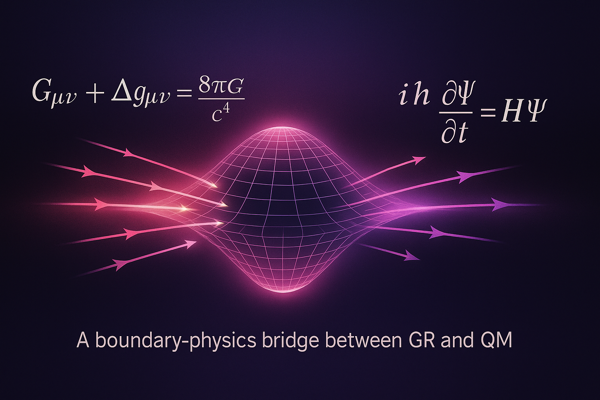
Designing laboratory experiments using Bose–Einstein condensate analogue systems to test predictions about quantised coherence structure in gravitational entanglement.
UCL Physics · Royal Holloway
Status: Experimental proposals active · NDAs signed
⬡
AI Orchestration
Internal deployment of reasoning and workflow stack across research and M&A applications. Commercial industrialisation under review.
Status: Deployed internally
⭐
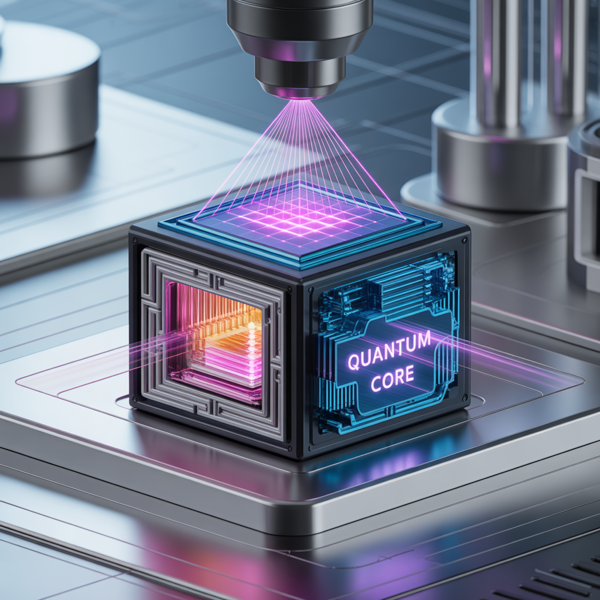
Quantum Photonics
Processor architecture progressing from simulation to fabrication partnerships. Room-temperature photonic cores.
Status: Validation in progress

⬢
LLM Toolkit
Discrete fine-tuning and evaluation methods enforcing physical constraint principles. Early adopter programme in preparation.
Status: Development and testing

⬡
Cosmology
Theoretical investigations into early-universe dynamics and large-scale structure, connecting quantum gravity frameworks to observational cosmology and CMB signatures.
Status: Active research
⭐
Standard Model
Geometric and topological approaches to Standard Model parameters, including derivation of mixing angles and mass hierarchies from first principles.
Southampton · Portsmouth
Status: Pre-print published
⬢
Information Theoretics
Foundational framework treating information as a physical substrate. Connecting entropy, coherence, and computational complexity to emergent physical phenomena.
Status: Theory development